AMD Showcases Ryzen 9000X3D Processors Achieving 1,000 FPS in Esports Titles
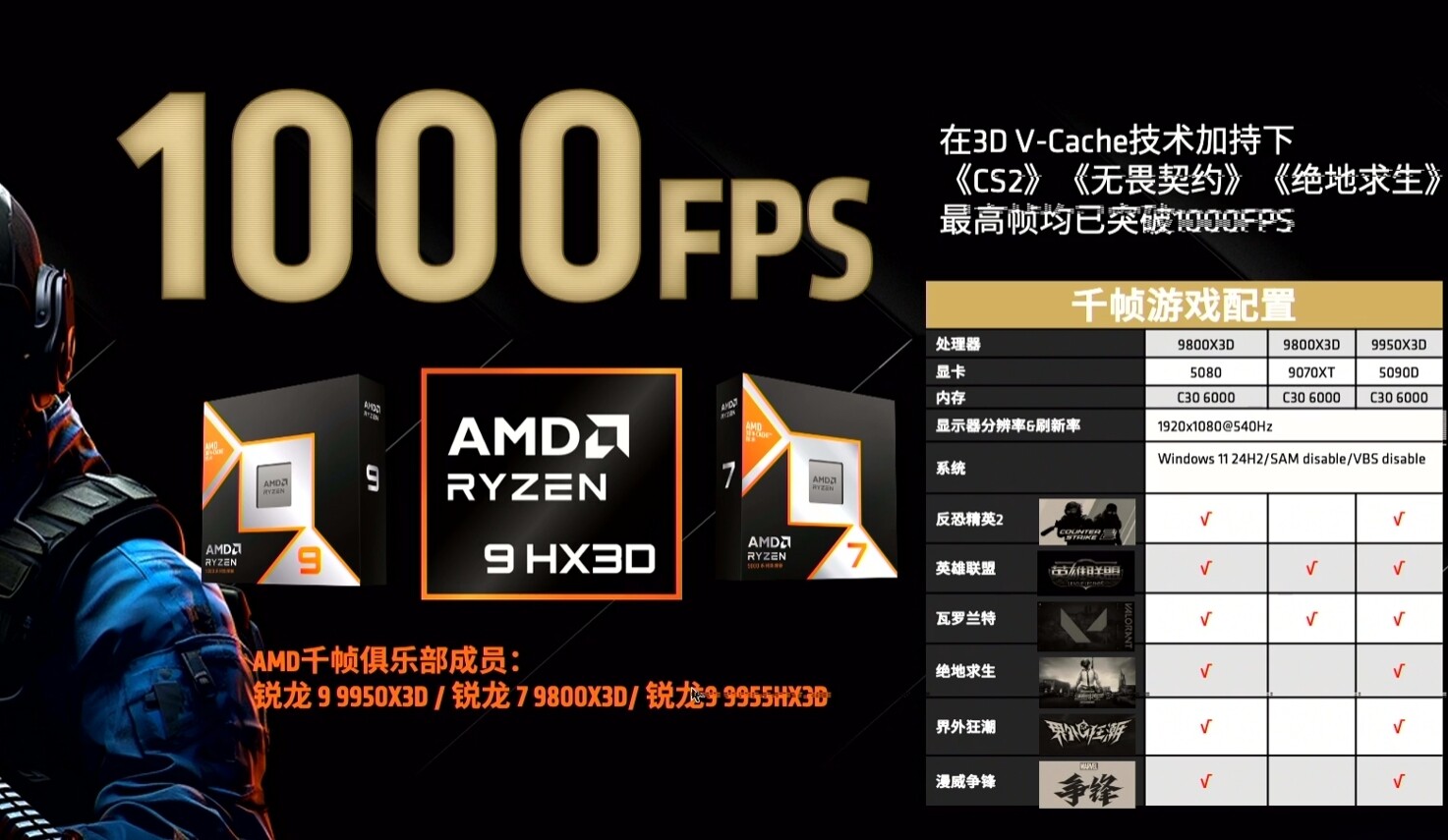
At a recent event in China, AMD unveiled impressive performance claims for its latest Ryzen 9000X3D series, highlighting the ability to reach 1,000 frames per second (FPS) in popular competitive esports games. This milestone, which AMD refers to as the "1000 FPS Club," sets a new benchmark in gaming CPU performance and underscores the company’s commitment to pushing the boundaries of gaming technology.
Breakthrough Performance with 3D V-Cache Technology
The processors showcased include the desktop Ryzen 7 9800X3D, Ryzen 9 9950X3D, and the mobile Ryzen 9 9955HX3D. AMD attributes these record-breaking frame rates to its innovative 3D V-Cache architecture, which stacks additional cache directly on top of the compute die. This design significantly boosts data access speeds, reducing latency and enhancing overall gaming responsiveness—an advantage particularly valued by competitive gamers and esports professionals.
During live demonstrations, AMD presented six leading esports titles—Counter-Strike 2, League of Legends, Valorant, PUBG, Naraka: Bladepoint, and Marvel Rivals—running at over 1,000 FPS at 1080p resolution. This achievement highlights the impact of advanced cache technology on real-world gaming scenarios, reinforcing the importance of CPU design in achieving top-tier gaming performance.
Test System Configuration and GPU Pairings
To reach these high frame rates, AMD paired the Ryzen 9000X3D processors with top-tier graphics cards. NVIDIA’s GeForce RTX 5080 and RTX 5090D were able to surpass the 1,000 FPS mark across all six tested games. In comparison, AMD’s own Radeon RX 9070 XT achieved this threshold in Valorant and League of Legends. The test systems were equipped with DDR5 memory running at 6000 MT/s with CL30 timings, and Windows 11 was configured with Smart Access Memory and virtualization features disabled to ensure optimal performance and minimal interference.
Technical Showcase and Future Implications
While current consumer monitors typically max out at around 720 Hz at lower resolutions, and true 1,000 Hz displays are not yet available, AMD’s demonstration serves as a technical showcase of what is possible with cutting-edge hardware. For professional esports players, the additional performance headroom could translate to lower input latency and a competitive edge, even if mainstream adoption of ultra-high refresh rate monitors is still on the horizon.
AMD’s latest announcement not only highlights the capabilities of the Ryzen 9000X3D family but also reinforces the ongoing relevance of CPU innovation in the pursuit of ultimate gaming performance.